The 7 Worst Things Good Parents Do by John Friel & Ph.D. & Linda D. Friel & M.A
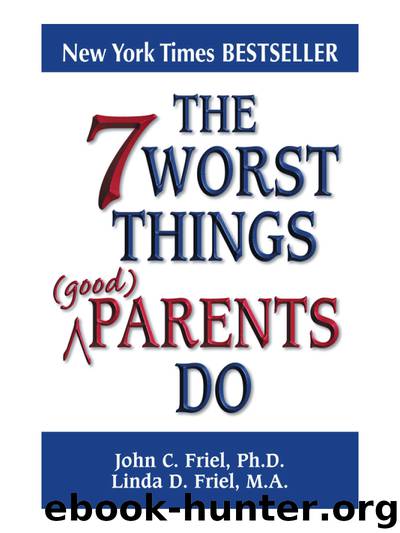
Author:John Friel & Ph.D. & Linda D. Friel & M.A.
Language: eng
Format: epub
Tags: book, books, worst, things, parents, do, john C. friel, linda d. friel, new york, bestseller
Publisher: Health Communications Inc
Published: 2015-03-25T16:00:00+00:00
8
FAIL TO GIVE YOUR CHILD STRUCTURE
A Brief Lesson About Structure
We know from the work of people like Jean Piaget, Erik Erikson, Jerome Bruner, Jane Loevinger and many others that children learn internal structure and discipline by first experiencing external structure. The sequence is quite simple. External structure first. The child gradually internalizes that external structure. Then internal structure forms. It’s as easy as 1-2-3.
But that’s not all. Internal structure is acquired in an identifiable sequence and this fact has not gone unnoticed in the critical field of impulse control. So, here’s how it works. Two Russian psycholinguists, Luria and Vygotsky, spent years studying how children’s inner speech develops and how children eventually use it to control their own behavior. In explaining their theory David McNeill wrote:
All control is a matter of following instructions, either external or internal. Self- or internal control depends on the development of inner speech, and inner speech in turn derives from socialized speech. Self-control is therefore preceded genetically by external control. (p. 1128)
This is fairly easy to grasp. Parents give directions to children such as, “Put the toy in the box,” or “Watch for cars before you cross the street.” Children hear these attempts to provide structure and direction. Children hear these directions some more. Eventually children say these directions to themselves. Voila! Children can control their own behavior by talking to themselves!
Then along came Harvard psychologist Lawrence Kohlberg, who put children’s private speech into four developmental stages. In stage one, children’s private speech has no control function—it simply consists of animal noises, playing with words, repetitive sounds and so forth. You know how this sounds. Your little one is sitting on the floor playing with a wooden block that he’s pretending is an airplane. He makes airplane noises. You crack up and remark on how cute he is. He’s yours, after all. You get to do that. But of course, in terms of language controlling behavior, there isn’t any of that going on here. During this stage, children’s language has no control over their behavior whatsoever. They’re just practicing making sound effects for their play.
In stage two, children talk out loud but they just address nonhuman objects or describe what it is they are doing, for example, “I’m jumping up and down! I’m jumping up and down!”
In stage three, children talk out loud but their speech definitely has a regulatory function. This is a crucial stage in children’s development, and is, we hope, greeted with excitement and enthusiasm by parents. As you watch and listen to your children using this kind of speech, be aware that you are witnessing one of the miracles of human development because what is happening is that your children are beginning to regulate their own behavior using the medium of language. It is the beginning of something profound. What you will observe, by the way, is your children saying things like this, out loud, but to themselves: “I have to put this block over here because it’s gonna fall if I try to put it there.
Download
This site does not store any files on its server. We only index and link to content provided by other sites. Please contact the content providers to delete copyright contents if any and email us, we'll remove relevant links or contents immediately.
The Lost Art of Listening by Michael P. Nichols(7508)
Rich Dad Poor Dad by Robert T. Kiyosaki(6645)
We Need to Talk by Celeste Headlee(5618)
I Love You But I Don't Trust You by Mira Kirshenbaum(3878)
The Complete Idiot's Guide to Coping With Difficult People by Arlene Uhl(3152)
Rich Dad Poor Dad: What The Rich Teach Their Kids About Money - That The Poor And Middle Class Do Not! by Robert T. Kiyosaki(2962)
A Burst of Light by Audre Lorde(2612)
The Book You Wish Your Parents Had Read (and Your Children Will Be Glad That You Did) by Philippa Perry(2528)
Dealing with People You Can't Stand by Dr. Rick Brinkman(2461)
Life Hacks by Dan Marshall(2456)
An Odyssey by Daniel Mendelsohn(2309)
The Expectant Father by Armin A. Brott & Jennifer Ash(2273)
Teach Your Child How to Think by Edward De Bono(2160)
No Time to Say Goodbye(2121)
What I Need by J. Daniels(2084)
The 7 Habits Of Highly Effective Teens by Covey Sean(2080)
The Anxious Generation by Jonathan Haidt(2058)
The Out-of-Sync Child by Carol Stock Kranowitz(2055)
I Don't Belong to You by Keke Palmer(2006)
